
Table of Contents
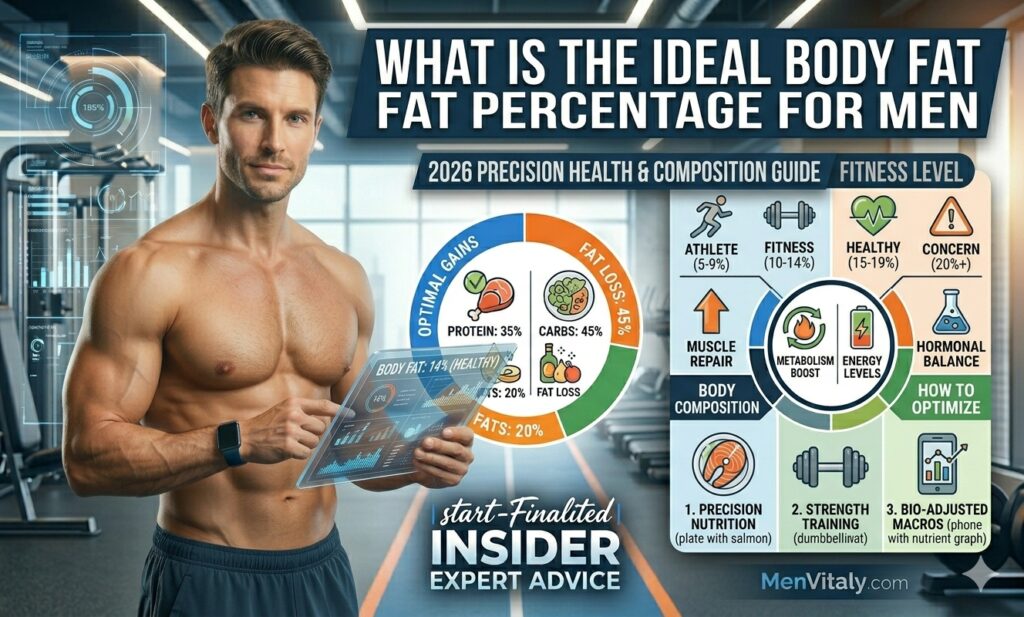
Understanding what is the ideal body fat percentage for men is the most significant factor in defining a truly high-performance physique in 2026. While many men focus exclusively on the scale, weight alone is a deceptive metric. A 200-pound man with 10% body fat looks and performs entirely differently than a 200-pound man with 30% body fat. For the men of the Menvitaly community, the goal is never just to lose weight—it is to optimize body composition by stripping fat while preserving elite lean muscle mass.
As we move through 2026, health standards have shifted toward functional vitality. The traditional “BMI” often misclassifies muscular men as overweight, which is why tracking your fat-to-muscle ratio with military-grade precision is essential. Whether you are aiming for the shredded “Athlete” look or a sustainable “Fitness” range, knowing your exact numbers allows you to adjust your training and nutrition with surgical accuracy. In this professional guide, we will break down the ideal standards for every age group and show you how to use the official Navy and Army tape test methods to track your progress from the comfort of your home.
Menvitaly Precision: Find What is the Ideal Body Fat Percentage for Men
Stop guessing with low-quality scales. Our 2026 Body Composition Analyzer uses the official U.S. Navy and Army tape test standards to give you a clinical breakdown of your Fat Mass vs. Lean Muscle Mass.
Calculated using official Body Composition Program (ABCP) and Navy standards.
The Elite Blueprint: Once you know your fat percentage, sync your nutrition with our Macro Calculator and track your resting metabolism with the BMR Tool.
Deep Dive: What is the Ideal Body Fat Percentage for Men in 2026?
Finding what is the ideal body fat percentage for men is a journey that changes as you age. In 2026, the “shredded” look isn’t just about aesthetics; it’s about metabolic health. Whether you are prepping for the Army Body Composition Program (ABCP) or just trying to look better in a t-shirt, your target range should be based on your specific life stage and activity level.
Body Fat vs. BMI: Why Composition Wins
The traditional Body Mass Index (BMI) often fails men who train hard. Because muscle is denser than fat, a muscular man can be labeled “Obese” by BMI while having a visible six-pack. This is why our 2026 Body Composition Analyzer is the superior choice—it looks at your actual tissue distribution. To see the difference, check your stats with our BMI Pro Tool and compare them to your fat mass here.
2026 Men’s Ideal Body Fat Chart by Age
| Age Group | Athlete Range | Fitness Range |
|---|---|---|
| 20–29 | 6% – 13% | 14% – 20% |
| 30–39 | 12% – 18% | 19% – 21% |
| 40–49 | 14% – 20% | 21% – 23% |
| 50+ | 16% – 22% | 23% – 25% |
How the Military-Grade Tape Test Works
The U.S. Navy and Army method is the gold standard for home assessments because it relies on the circumference of your neck and waist relative to your height. Unlike scales that can be influenced by water weight, your measurements tell the real story of your fat distribution.
- Waist Measurement: Crucial for identifying visceral fat around the organs.
- Neck Measurement: Helps the algorithm distinguish between structural mass and adipose tissue.
- Lean Muscle Mass: By knowing your fat mass, our tool reveals your exact Lean Muscle Mass (kg), which is the engine driving your resting metabolism. Calculate this energy need with our BMR Calculator.
🔬 Clinical Insight:
“High visceral fat is a primary indicator of metabolic disease, making body fat percentage a more critical health marker than total body weight.” — Research provided by the American Council on Exercise (ACE).
Next Steps: How to Reach Your Ideal Range
Once you discover what is the ideal body fat percentage for men in your category, the work begins. If you are above 25% (classified as Obese/High Risk), focus on a caloric deficit and high-intensity resistance training. To fuel this transformation, ensure your protein levels are high using our Protein Tool and adjust your energy ratios with our Macro Calculator.
Explore Our Health & Fitness Toolkit
- Decoding the Van Gogh Paradox: “The More You Love, The More You Suffer”

- [The Exterior Blueprint] 7 High-ROI Secrets to Instantly Modernize Your House Exterior Design
- Beyond the 9-to-5: What is Website Earning (And How Modern Men are Building $10K/Month Digital Assets)
- The Waking Protocol: 5 Quick Daily Habits to Trigger Aggressive Testosterone Spikes The 2026 Blueprint
- The Ultimate Weight Lifting Routine to Lose Weight and Build Lean Muscle







Pingback: Natural Semaglutide Alternatives Men: 5 Proven 2026 Boosters
Pingback: Best Nitric Oxide Boosters 2026: The Nobel-Prize Science Guide
Pingback: Top Rated Smart Rings 2026: The Ultimate Professional Tech Guide
Pingback: Best Portable Infrared Sauna 2026: Ultimate Pro Recovery Guide
Pingback: PMOS Metabolic Syndrome Guide 2026 The Ultimate Vitality Shift
Pingback: Apple iOS Health Update 2026: Elite Performance Master Guide
Pingback: Dead Hang Spinal Decompression: Why Men Need This Daily Protocol | Menvitaly